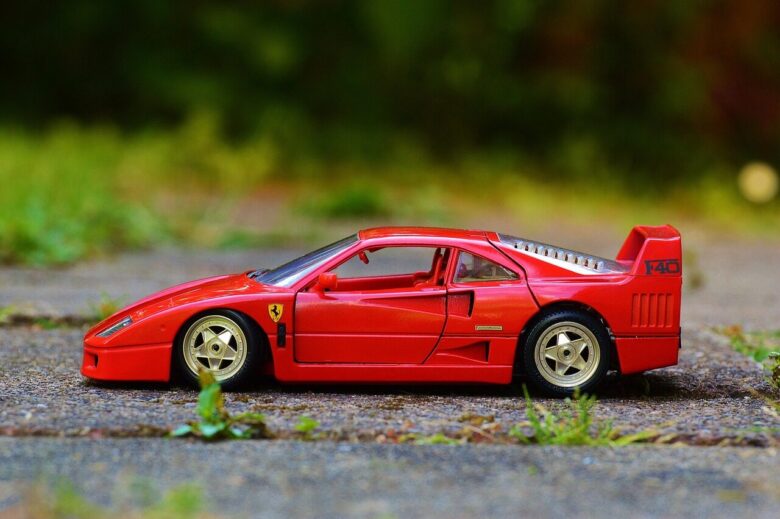
A convincing candy or pearl finish is not created by one spectacular coat of paint. It is created by several optical layers working together.
The ground color changes what passes back through a transparent candy layer. Pearl particles interact with light above or within the color system. The final clear then provides gloss and allows the effect underneath it to be seen cleanly.
On a resin model car, controlling those layers is especially important because a small change in color density can be obvious when the hood, roof and quarter panels are viewed together.
Primer, ground coat, effect layer, number of passes and clear coat can all change what the finished model looks like.
Pearl and Candy Are Not the Same Effect
Pearl materials can be supplied as pre-mixed colors, transparent effect colors or particles carried in a compatible medium. The amount and the color underneath them influence the final appearance.
A true candy system uses transparent color so the reflective or colored ground underneath continues to influence the finish.
Createx currently describes its candy2o line as transparent colors intended to work as mid-coats over metallic bases, among other uses. House of Kolor likewise builds its Kandy systems around multiple components and underlying effect or base layers.
That distinction matters because you cannot judge a candy color accurately by looking at the liquid in the airbrush cup.
Start With a Paint Stack
Prepare the Resin Before Chasing Color
Pearl and candy finishes emphasize reflections. That means they can also emphasize surface defects.
Remove support marks, level visible print artifacts and inspect the body under primer before applying the expensive or difficult color layers.
Formlabs’ current painting workflow recommends sanding support marks and the surface, cleaning away sanding residue and then applying primer. The first primer coat can be used as an inspection layer so remaining defects can be corrected before the final primer coat.
The exact sanding sequence and primer chemistry should be appropriate for your resin and paint system rather than copied blindly from a different material.
The Ground Coat Controls More Than You May Expect
A transparent or semi-transparent effect does not completely hide what is underneath it.
House of Kolor’s current pearl documentation explicitly changes its pearl-loading guidance depending on whether the underlying base is light or dark. Tamiya also describes LP-49 Pearl Clear as an effect applied over a base color rather than as an opaque replacement for that color.
This means the same pearl effect can look substantially different over black, white, silver, red or another color-keyed base.
Make your test sample with the same primer and ground color you intend to use on the model body.
For Candy, Count Coats Instead of Painting Until It “Looks Right”
Transparent color becomes deeper as more material is applied. If the left door receives one additional full pass compared with the right door, the difference may remain visible even after clear coat.
Createx currently recommends multiple medium-wet coats for full saturation of its candy2o system. House of Kolor’s current Kandy instructions also emphasize controlled overlap and spraying continuously along the object rather than painting individual panels separately.
The exact number of coats is product-specific. The useful habit is recording them.
Each test sample should use the same primer, ground coat, spray setup and clear system.
The visual colors above are only an illustration of increasing density; they are not a formula for a real paint.
Once the physical test cards are dry and cleared, compare them under the lighting where the model will normally be displayed. Mark the chosen card and keep it with the paint notes.
Uniformity Matters More Than Maximum Saturation
Candy paint can reveal inconsistent technique because each overlapping pass adds transparent color.
House of Kolor’s current application instructions emphasize consistent spray-pattern overlap and recommend spraying the full length of the object rather than treating each panel independently.
That principle translates well to model-car bodies.
Instead of finishing the hood completely and then moving to the door, make controlled passes across the body so connected panels receive a similar amount of effect color.
| Visible problem | What to investigate before adding more paint |
|---|---|
| One panel looks darker | Unequal number of candy passes, heavier overlap or more material deposited in that area. |
| Pearl looks patchy | Particle distribution, atomization, overlap and whether the effect material remained consistently mixed. |
| Color changes dramatically after touching up | Transparent candy density has increased locally. |
| Effect is much stronger than the test sample | Different ground color, coat count, mixture or application thickness. |
Keep Pearl Material Suspended
Pearl and effect particles can settle in a paint mixture. The exact behavior depends on particle type and carrier.
House of Kolor even produces dedicated intercoat carriers intended to reduce settling and help pearl and flake particles remain more uniformly distributed during application.
For hobby-scale painting, follow the instructions for the exact effect product and keep the material consistently mixed without introducing unnecessary contamination or bubbles.
If the first half of a body receives a different concentration of pearl from the last half, uniform airbrush technique alone cannot correct the mismatch.
Scale Changes How an Effect Looks
A dramatic custom-car flake that looks appropriate on a full-size vehicle can appear visually coarse on a 1/24 body.
For scale replicas, judge the effect from normal viewing distance rather than only under magnification. The goal is usually to suggest the optical behavior of the original finish without allowing individual effect particles to dominate panel lines and body proportions.
Fine pearl products made for model painting can be useful when a subtle effect is desired. Tamiya’s current model range, for example, includes Pearl Clear as well as dedicated pearl colors.
Do Not Mix Products Just Because Both Containers Say “Clear”
A transparent color, an intercoat carrier and a final clear coat can perform very different jobs.
Createx, for example, identifies 4050 UVLS Gloss Clear as a mixing/carrier medium for several of its effect products as well as an intercoat. House of Kolor specifies particular carriers and topcoats within its own systems.
Tamiya LP-49 and TS-65 are lacquer-based model products with their own intended application.
A House of Kolor mixing ratio, a Createx candy2o ratio and a Tamiya lacquer-thinning procedure are not interchangeable recipes.
Build a Repeatable Color Recipe
Evaluate the Finish in More Than One Light
Pearl and metallic effects change with viewing angle and illumination. House of Kolor specifically notes that pearl effects are especially apparent in sunlight.
Inspect the finished test outside in indirect daylight, under the workshop lighting and under the lighting used for photography or display.
A pearl that seems subtle under diffuse indoor lighting may become much stronger in direct light.
Clear Coat Is Part of the Final Appearance
The effect layer should not be treated as the finished surface unless the specific paint system is designed that way.
A compatible clear can provide gloss, surface leveling and protection, but it also changes how light reaches the color underneath. That is another reason the test card should include the final clear rather than stopping at the candy or pearl layer.
Follow the manufacturer’s flash, recoat and curing instructions. Do not invent a universal waiting time between different paint chemistries.
Keep Automotive Coating Safety Separate From Hobby Paint Assumptions
Some custom automotive systems use solvent-rich products and certain two-component coatings can contain isocyanates.
NIOSH identifies ventilation, suitable spray equipment and appropriate respiratory and skin protection as important controls for spray-paint exposure. Isocyanate-containing coatings require particular care because respiratory and skin exposure can cause sensitization.
Read the Safety Data Sheet for every product in the system. A coating sold for professional automotive refinishing should not be treated as though it has the same hazard profile as an ordinary water-based hobby paint.
Prepare the resin surface, choose the ground color deliberately, build the effect in controlled passes, record the number of coats and evaluate the final result only after applying the intended compatible clear.
Official technical references
The pearl, candy, resin-preparation and spray-safety principles in this article were checked against current manufacturer and occupational-safety documentation.
- Createx Colors — candy2o Hobby System
- Createx Colors — Current Mixing and Carrier Guidance
- House of Kolor — Shimrin2 Kandy Basecoat Technical Data
- House of Kolor — Shimrin2 Pearl Technical Manual
- Tamiya — LP-49 Pearl Clear
- Tamiya — TS-65 Pearl Clear
- Formlabs — Preparing SLA Prints for Painting
- NIOSH — Control of Paint Overspray
The LS Resin Lab Editorial Team manages and reviews the site’s educational content on resin modelmaking, SLA printing, painting, finishing, workshop safety, and related workflows. Articles are maintained for clarity, accuracy, and practical usefulness. Readers can report corrections or contact the editorial team through the Contact page on LS Resin Lab.